James Wagner

Artists Space: homos and Reaction
ScherJuliaSecurity.jpg
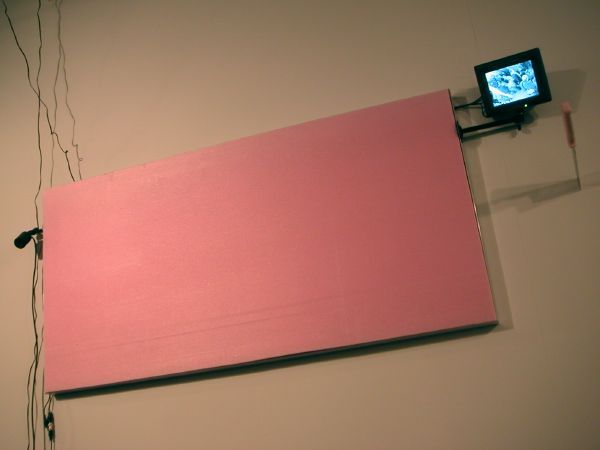
Julia Scher Security Landscape of the Year 2004 metal, monitor, Styrofoam, camera, knife, string, metal frame 24" x 47.75" (dimensions vary with installation) installation view

In spite of their other, more social pleasures, opening receptions are never a good time to see a gallery or museum show, so I will have to suspend most of my usual (innoxious) judgments about the new Artists Space exhibition, "Log Cabin." The name of the show is a reference to the scary national right-wing gay organization (and much-abused victim of unrequited elephant love), the Log Cabin Republicans, and it aims to examine the impact of reationary politics on representations of the queer experience and on the creative expression of queer artists.

Jeffrey Uslip, the young curator, has assembled an interesting group, and I'm delighted that it includes a number of names with which I'm totally unfamiliar.

But of course some were more than recognizable. I've written about Scott Treleaven several times in the past and I think I've watched the fluid development of his collage work almost from its very beginnings with a zine and a brilliant video. Because of that and because it is installed very smartly in a separate room in the Artists Space environment his contribution (which is actually something of a mini-retrospective, although that seems ludicrous, since the artist looks barely out of his teens) came together and really stood out, at least for me, even in the midst of the large enthusiastic crowds which came out of the cold on Tuesday, the night of the opening reception.

I will definitely go back for a better look at each of the other artists' work, much of which I confess was pretty baffling without enough room to see it or a proper scorecard. Among many other pieces only half-seen that night, I'm curious about Allison Smith's sculpture installation, "Flagging Stack Arms," Terence Koh's "29 seconds of attraction," K8 Hardy's "Trying to Talk," Paul Pfeiffer's video "Empire," which is described as of three-month duration, Julia Scher's "Security Landscape of the Year," and the very un-Republican imagery of Ken Gonzales-Day.

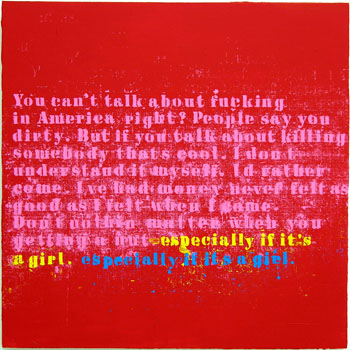
Andrew Solomon managed to garner two separate, modest-size spaces with two very different works, and he deserved both of them. We love Dave Burns! I hardly had more than a glimspe of the various video works spread throughout the rooms. Dean Sameshima's photographs are always sexy (even when they include no human figure) but that's always only where they start. Any show in which Glenn Ligon's work (here, one piece descibing four wonderful texts* on canvas) is among the most accessible is definitely worth some serious visiting time.

*
LigonGlennnut.jpg
Glenn Ligon Especially If it's a Girl #1 2004 oil and acrylic on canvas 30" x 30" detail

the complete text of this section of the piece reads:

You can't talk about fucking
in America right? People say you
dirty. But if you talk about killing
somebody that's cool. I don't
understand it myself. I'd rather
come. I've had money never felt as
good as I felt when I came.
Don't nothing matter when you
getting a nut - especially if it's
a girl, especially if it's a girl.

Evan Schwartz and Michael Waugh

Schwartzbirthday.jpg
Evan Schwartz Birthday Party 2004 digital C-Print 30" x 24"

Schwartzbedphone.jpg
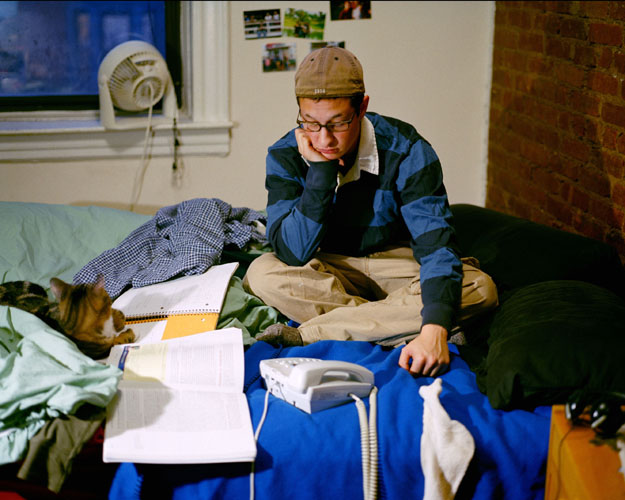
Evan Schwartz Waiting by the Phone 2004 digital C-Print 30" x 24"

Evan Schwartz has his first solo gallery show and it dazzles, with both the bold inventions of his art and the infectious joy (and sad frustrations) of a second puberty - this time the one he really wanted.

The Schroeder Romero press release explains:

Evan Schwartz was born in Chicago, Illinois, in 1982 under a different name and gender. His new photography series Reclaiming Puberty, is a maturing timeline about growing up as a girl into a man. Through this self-exploration of gender and sexuality, Schwartz painfully discovers that in order to become the man he's always wanted to be, he must go through the perils of adolescent boyhood first - after already experiencing adolescence as a girl.

The gallery installation follows chronologically her childhood and youth, documented in family photos, through a self-documentation of the courageous transformation process which permitted him the ordinary joys and frustrations recorded in the last images in the show, two of which are shown above.

Schwartz is currently a student of photography at Pratt Institute. I'm sure we will be seeing a lot more of his work, whatever form it may take.

Waughhandsdetail.jpg
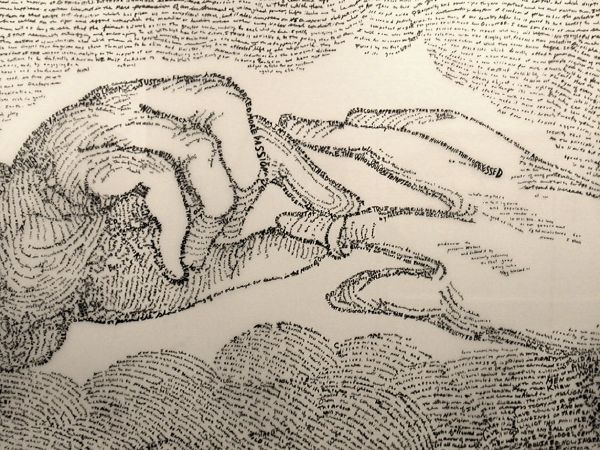
Michael Waugh Inaugural 2004 ink on mylar 36" x 78.5" detail

In the Project Gallery space Michael Waugh has installed a number of his text-drawn and text-painted works in [dis]honor of the frightening annointing process the nation will witness tomorrow on the capital steps. Waugh's images allude to homosexual desire and identity. They are immediately and profoundly beautiful, as they always are in his work, but their relationship to the historical phrases of which they are mostly composed is profoundly disturbing, especially in the reality of the perverted politics of today.

[images at the very top from Evan Schwartz]

Hearst Tower diagonals

Fosterdetail.jpg

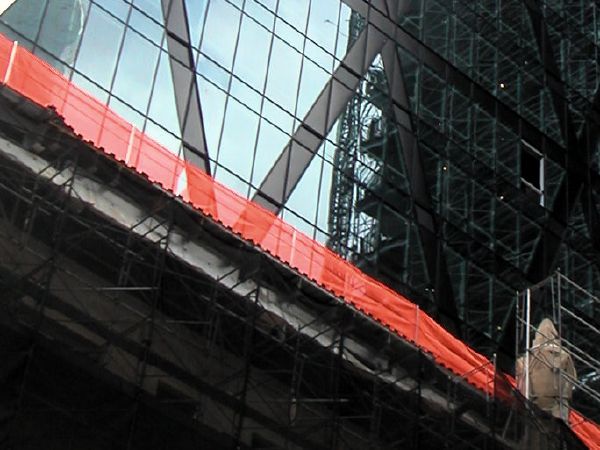
I hadn't noticed until recently that Sir Norman Foster's exciting project for completing the 1928 Hearst Building in midtown Manhattan includes a relatively small but significant salute, or nod, to the design of the art deco original.

In the photo above, note the chevron shapes on the stylized urns at the top of the surviving shell of the early building. These ornaments are repeated all along the parapet. Foster's tower rises above all this, and uses its diagonal device structurally, on an enormous scale.

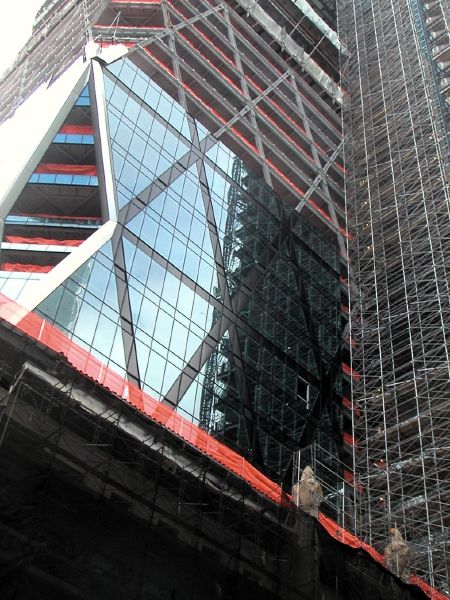
The photo below shows much of the current height of the massive new construction, and the top eight floors are still to be built. That is, otherwise imagined, there are still two layers of triangles or one full layer of X-bracing to go up beyond what you see on the street today. The completed building is going to look much larger than it appears in the architects' renderings.

Fosterfull.jpg

Paper Rad and Cory Arcangel

CoryNintendocartridge.jpg
where the magic lives

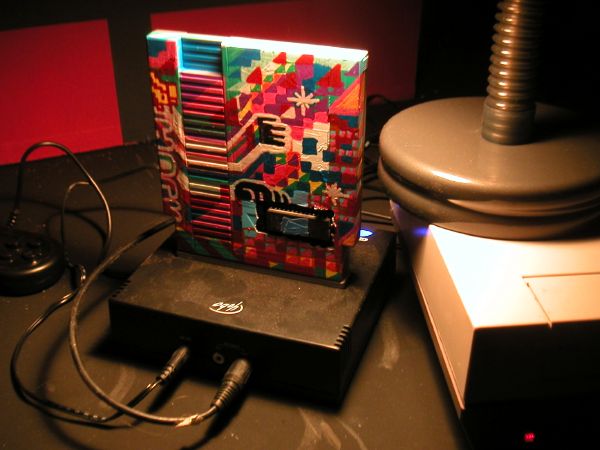
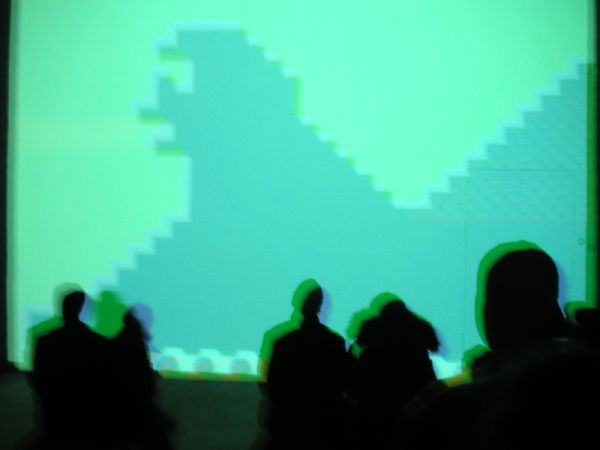
Last night's opening at Deitch was an almost ecstatically-happy sorta-rave made up mostly of artists and computer nerds. The output of this little machine, an altered vintage Nintendo cartridge, sitting on a black platform in the corner of the room, was what attracted the overflow crowd. The machine itself was the product of a particulary felicitous collaboration between Paper Rad and Cory Arcangel.

Tom Moody describes the work - in two posts.

CoryPaperRMario.jpg
impression of the scene of the "Super Mario Movie" projection, unfortunately minus even a hint of the great soundtrack

Cory Arcangel travels with sound and light

ArcangelTetris.jpg
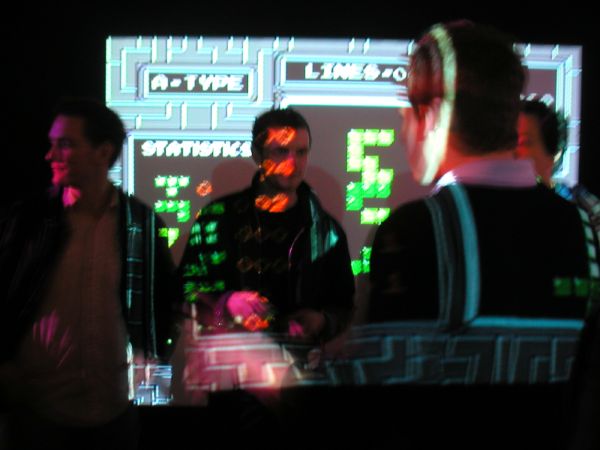
a view of some of the pleasures of the Cory Arcangel opening at Team Gallery last Thursday

He's a creative genius and a master with the modern tools he has chosen. Cory Arcangel is also one of the nicest, most likeable, winsome, and approachable people I've ever met. All of this just makes his genuine modesty pretty incredible.

His happy art (can I say that?) speaks for itself, and it will speak to just about anyone. In New York we've gotten used to thinking of Cory as our own, although beginning next week he will be showing work in Vienna, Salzburg, Zurich and London. Fortunately, both because of his fecundity and the nature of his chosen media, there will always be plenty to go around.

Arties in Europe should see the Galerie Lisa Ruyter site and click onto "project space" for information on his appearances.

Anyway, he'll be in our town for another few days. Enjoy the show which opened at Team Thursday night, "Welcome 2 my Homepage Artshow," and visit his collaboration with Paper Rad at Jeffrey Deitch in Soho anytime between tonight's opening (it's sure to be a wonderful zoo) and February 26, when it closes. The show at Deitch is called "Super Mario Movie."

Oh yeah, there's also a performance scheduled at the Swiss Institute - Contemporary Art on Tuesday, February 1, at 7pm, so our boy won't be staying long in Vienna.

On the screen in the image at the top is a projection of what the Team Gallery press release describes simply as "an absurdly slowed down version of Tetris®."

For more on the Team show, see Tom Moody's notes.

Thomas Lendvai at Plus Ultra

LendvaiThomasEdBarry
Thomas Lendvai's installation at Plus Ultra, as seen during the opening reception, with Ed Winkleman and Barry Hoggard showing as prairie dogs*

It's great fun, even if you couldn't be there for the cheer of the opening. Thomas Lendvai's plane of wooden joists has cut through the Plus Ultra space at a rakish angle, totalling re-configuring the white box and challenging the ordinary conventions of architectural space. There's nothing else in the gallery, but if you tried to add anything more than the bodies and faces of visitors attracted to this striking, minimal show (installed in one of the smartest galleries in the city) the room would be visually destroyed.

Fortunately, on the evening I stopped by those additions were all very beautiful.

* the analogy was Barry's, and it just popped out when he saw the image

Cuchifritos really goes to market this time

TaylorJanice.jpg
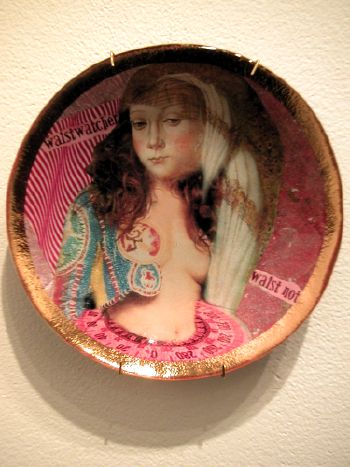
Janice Taylor, one plate from the series, JustDesserts

MissingPeter.jpg

Peter Missing, handmade poster

BeckerCharlie.jpg
Charlie Becker, handmade action figures, from a series

There are few spaces where a show called "Represented by Retail" would be more appropriate. The non-profit art gallery/project space Cuchifritos occupies a conventional store unit at one end of a colorful and historical indoor market on the Lower East Side. [note for western downtowners: the Essex Market is something like Chelsea Market, but with a soul]

The exhibition, as described on the gallery site by its curator (and director of the gallery) Paul Clay, "Explores a new crop of artists who are represented as much through retail stores as by galleries." But don't jump to conclusions about crass commercialism or the quality of work offered directly to an open market. More from Cuchifritos:

Critics from this urban/street/corporate scene see contemporary artists as modifying their output to make it gallery-ready and collector-appropriate, which they see as no different from making art that is corporate-acceptable, as long as they feel the primary qualities of their work are still getting out into the world. Some see contemporary artists as simply cobranded with a gallery rather than a corporation, and like galleries, there are good and bad corporations to hook up with. The quest to maintain a level of integrity is the critical goal.

Cobranding of products is seen by many as a dilution of the art by corporate goals in sponsorship, but what is happening now can be read as the artification of commercial products. Viral transmission of art into the commercial product arena.

Making better things through art, every day.

cardboard art

Cardboard-boat_UASA_SP03_4c.jpg

I love cardboard. It's warm, accessible, forgiving and versatile, and it comes in all sizes, colors and surfaces. It's also totally without pretension, even when it's pretty expensive. All these virtues describe the stuff before it's been worked, and sometimes the work really moves.

While one afternoon's experience doesn't suggest a school, as we were heading home last night I thought about the fact that in three gallery stops and one studio visit this humble material had been the basis for most of the art we had seen. Odd. Maybe it was only because all of the venues were very downtown, but it actually seemed very right.

[image from California State University Chico]

Patrick Grenier and Silo

GrenierPatrick.jpg
Patrick Grenier Make Room for Dada, Constructivism and Suprematism 2004 cardboard, ink, glue, metal, wood and paper 120" x 252" x 204" installation view of interior

It's a beautiful space, and it's in an alley much too interesting to be a part of the New York grid, but it is, and it looks like now there's going to be another reason to visit Freeman Alley besides Freeman's.

The gallery is Silo, and its current beautiful, very timely (but obscure?) show, "Wrestling With Architecture," is of work by Patrick Grenier. Grenier addresses the relationship between art and the spaces where art is made at home - or not. All of it seems to be about the Museum of Modern Art. I think he's just asking the questions, which is probably alright, since there are all kinds of answers out there.