James Wagner

an opera house for all folks
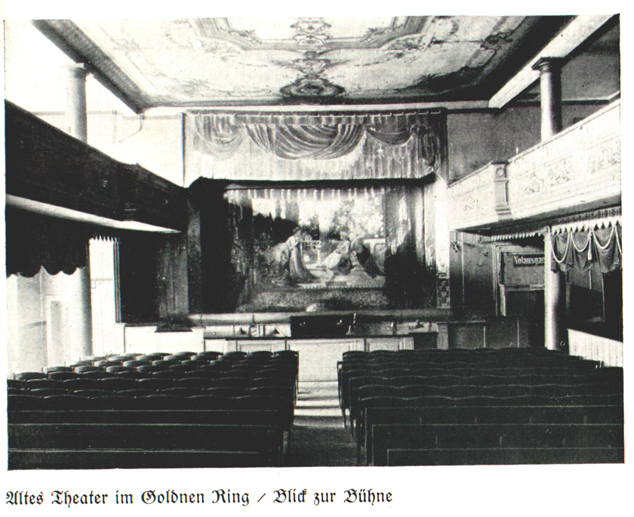
AltesTheater.JPG

I came across the link where I found this picture while looking for images of the "Dada Baroness," Elsa von Freytag-Loringhoven [she seems to have had an early and remote connection to the theatre shown above].

Wouldn't it be wonderful if everyone had access to such a performance space in their own community? I mean wonderful for both audiences and artists!

When I saw this century-old picture of a basic, but absolutely complete theatre inside a small hotel in the provincial German town of Cottbus I thought about opera, and what fun it would be to see small productions in a space like this. Well, okay, I was also thinking of a scene in Fellini's "Amarcord." In our own experience, New York at least never seems to run out of spaces for non-musical theatre, so I thought it was fair to talk specifically about an opera house, maybe one in the west 20's for instance. The hall shown above seems to have everything audiences and artists need, just a lot less of it. There's a stage, curtains, an orchestra pit, parquet seats, boxes to see and be seen, wings, possibly a backstage area, carved or painted decoration, and even something most larger theatres don't have, daylight when the large windows don't have to be darkened.

It seems so simple. If a modest inn located in a provincial central European town could have this little jewelbox of a theatre, why can't every town in America?

We know the answer, of course, because there was a time when every small town in America, and virtually every neighborhood, did have these stages, even if their productions might be high, low or anything in between. Then cinema appeared, and live entertainment began to disappear. Later, when television entered every home in America, if not every room and now most every SUV, the audiences stopped showing up altogether.

But today, for reasons discussed regularly in the cultural media, opera, especially new creations, and including work which would not be acknowedged as opera by the old guard, is once again hot and getting hotter. This is especially true in Europe, where there are still stages in every modest-sized town, most in appropriately-sized halls, and where there is serious public funding. But people everwhere seem to like what they are seeing and hearing - if they can find it. The boundaries between high and low are becoming blurred, with neither suffering diminishment. Once again, after almost a hundred years, whether grand or chamber/loft-sized, opera isn't just for the elite, even if usually we can no longer whistle its new melodies in the streets.

I say let the Metropolitan Opera go on doing its museum thing in its big colliseum for increasingly older and wealthier audiences, but let's create our own opera houses, and produce our own brand-new, unjustly-neglected or re-created operas, and let's do it everywhere.

Although even the small halls I am imagining would need money, in the U.S. we would need only a fraction of the private or public [hah!] patronage which is thrown at television. Decades ago our government handed over the airwaves, which belong to the people, to a very few huge corporations which profit from an infinite number of other corporations which in their turn profit from selling stuff to the people who have been robbed of the patrimony of the airwaves. It's an outrageous scam.

We need to get back what is ours, meaning the tools, both theatres and airwaves, with which we might build a culture beyond mere consumerism.

More opera, less soap.

[image from Klaus Martens (scroll down)]
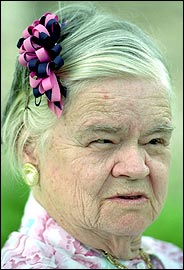
just crazy about dancing and such things

PettyOpal.jpg
Opal Petty 1918-2005

She was 16 when her family had her committed to a mental hospital.

"Being fundamentalist Baptists her family didn't approve of her wanting to go out dancing and such things. A church exorcism didn't work, so the family made the decision to commit her."

The quote is from the director of the Texas Civil Rights Project, Jim Harrington, the man who fought successfully for Opal Petty's right to return to society after 51 years.

She died one week ago at the age of 86, damaged by an "institutional syndrome," but having lived nearly twenty years with people who loved and cared for her, and who were responsible for her resurrection.

Petty's story should strike a painful chord in the hearts of most girls and women, and certainly queers of any age, who as little children were chastised by their families, to any degree, for behaving inapproriately. Some of us make it through.

[1994 image by Larry Kolvoord/The Austin American-Statesman via the NYTimes]

happy meals

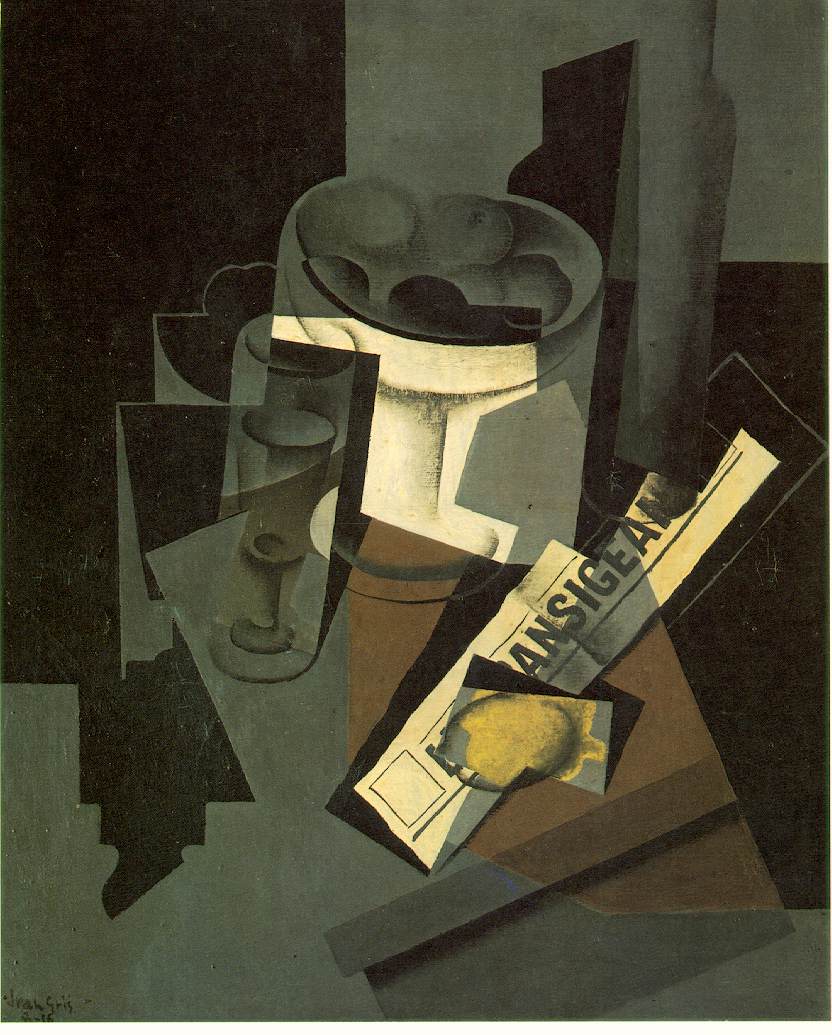
gris.glass-lemon.jpg
Juan Gris Fruit Dish, Glass, and Lemon (Still Life with Newspaper) 1916 oil on canvas 28.75" x 23.5"

I don't know anything about cooking, but I know what I like. No, that's not quite right. I do know something about cooking, and I know when it's right, but I'm not really a creative chef. When it comes to the things I love (including the arts) maybe I usually get by with only an intense curiosity about the new, a certain amount of taste and a good deal of almost-academic deliberateness.

I started cooking years ago while a graduate student at Brown. Perhaps imagining myself more impecunious than I really was, I convinced myself that learning to cook would be the most reliable way to be certain that I would eat very well - at least some of the time.

I can report right now that two nights ago Barry and I ate really well. No, it wasn't the first time, but I did get pretty excited about it, partly because it was so unexpected - and so easy. It's now Wednesday, and the immediate near-ecstasy of the moment has passed, but I told myself while clearing the table on Monday that I had to write about a meal which, although rather casually assembled, ended up an almost perfect little Italian table. I wish I could pull that off every night, and even more to the point, I wish we could share it with others more often than we do.

I had spent several final hours at the Armory show that afternoon while Barry stayed home to work, and when I returned home I wanted to go through mail and post a bit before dinner, so my early-evening Whole Foods trek for provisions was more perfunctory than usual. At the market I decided on squid (I know, it was don't-buy seafood-on-Monday, but they looked and smelled great) and some very fresh-looking broccoli rabe. While there I remembered I had a small net of golden fingerling potatoes hanging on a hook at home.

Altogether it was a pretty modest Italian meal, especially since only if I were to count our eager "seconds" could I begin to relate it to the three or four courses and dessert tradition:

Dressed Squid briefly roasted in the oven together with crumbled red chilies, dried oregano, a bit of olive oil and the juice of half a Meyer lemon;

potatoes on the same plate, also roasted in a baking dish in the oven, but for a full half hour, after being cut lengthwise into four pieces, mixed together in a bowl with chopped garlic, oregano leaves (the recipe had specified marjoram, but the larder showed only the fresh form of the dried herb called for with the squid), a little olive oil and this time two lemons, each cut into twelve wedges and squeezed with the rest of the ingredients;

the very green contorni, served in separate bowls, was the rabe, quickly boiled, drained and then sauteed in a pan which had first heated a few garlic slices in olive oil;

the wine was a simple bottle of Fiano Di Avellino from Campania.

The pleasures were of both the palate and the eye, as they must be with a good meal.

I was amazed at how fantastic the seafood and the potatoes both looked and tasted together, and the vegetable was as perfect a visual contrast as it was a gustatory one.

The cooking utensils, my old white-lined blue enamel NACCO baking pan for the squid, a red-brown terra cotta rectangular pan for the potatoes and a heavy, black Wagner iron frying pan for the greens, all eventually found a home on top of our high-legged dark green and cream deco 73-year-old range, but there never seems to be time for pictures at these moments. Sitting at the old maple turned-leg drop-leaf in the breakfast room we ate off sturdy cream and mushroom-colored Shenango restaurant ware, with small lightly-tinted ribbed-glass Duraflex kitchen bowls on the side for the greens. Once again we found this really good homey restaurant in the middle of Manhattan; we'll be going back.

The recipes I used for the squid and the potatoes are from the really excellent "Italian Easy: Recipes from the London River Cafe
by Rose Gray and Ruth Rogers, which is accurately summarized in Amazon's editorial review: "These are visually spectacular, remarkably simple recipes for those who love good food but have little time to prepare it."

[image from the Artchive]

Eric Doeringer at apexart

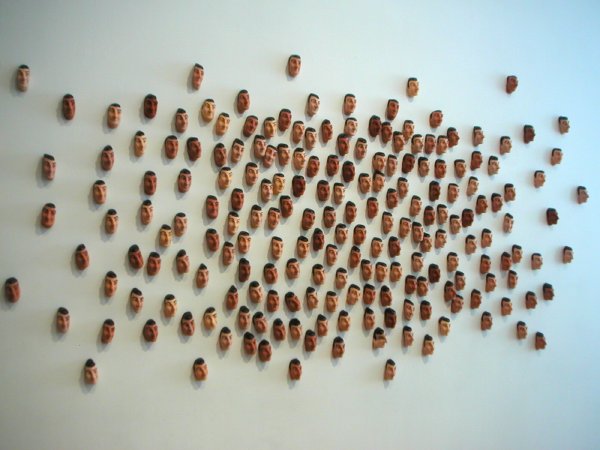
DoeringerCatalan.jpg

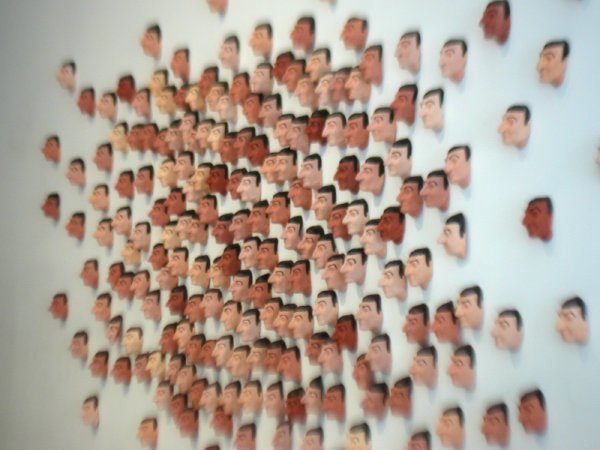
DoeringerCattelan.jpg

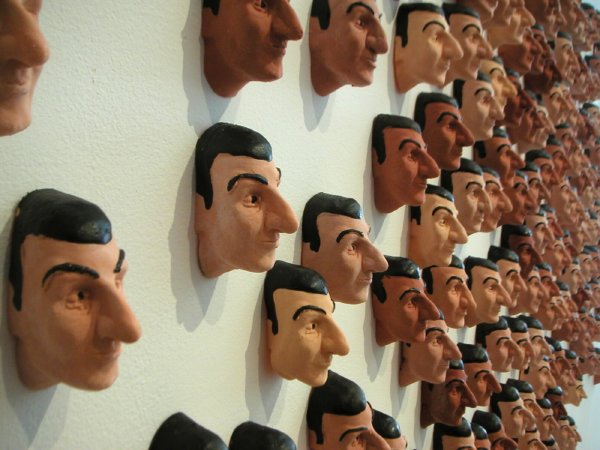
DoeringerCattelan3.jpg

As far as I'm concerned there's never enough of Maurizio Cattelan to go around, but now Eric Doeringer is helping out - with a wonderful additional conceit.

As I understand it Cattelan had been invited by apexart to do something in their space. What they ended up with was "Maurizio Couldn't Be Here." This was a series of five Saturdays of performance-related events organized by five different people invited by Cattelan to curate shows in the Church Street space. For the final Saturday the curator Fernanda Arruda picked Doeringer, and Doeringer created a new unlimited edition for the occasion, a hand-painted latex mask (miniature, of course) of Cattelan's face. Behind a black curtain dividing the gallery on Saturday, in addition to pushing his earlier product range of "Bootlegs" of hot artists, he was offering a ziplock bag of five miniature masks for $100 (a price at or near the high end for his pieces).

No surprise, but I understand Cattelan himself is a Doeringer collector.

Sorry about all the images; I couldn't help myself. I just had to put up all three of my pictures of the front-room installation. And yes, we did buy a bag of Doeringer Cattelans while there.

Korpys/Löffler at Armory

KorpysLoeffler.jpg
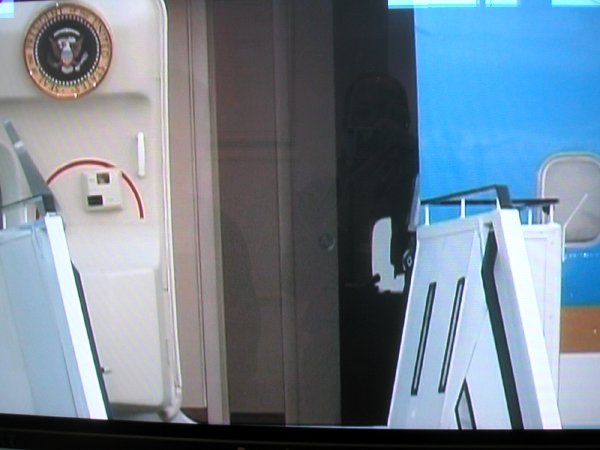
Korpys/Löffler The Nuclear Football 2004 DVD still from video

I almost couldn't tear myself away from a video by André Korpys and Markus Löffler shown by Karlsruhe's Meyer Riegger Galerie at the Armory show. And when I did, it was only to come back each time I passed near its images or heard the refrains of "Hail to the Chief" on its soundtrack.

A sexy male voiceover whisper accompanies a thirty-minute newscam-like documentary of Bush's lightening-fast 2002 visit to Berlin, framed by the arrival and departure of Air Force One. The visible security systems are the stars of the video. Barry and I think we heard something like "secret service men make me hot," but we could be wrong. The title refers to the leather bag which always closely accompanies an American president, the one which holds his special nuclear cellphone.

Dr. Sabine Maria Schmidt's press release for Korpys/Löffler's exhibition at the Wilhelm Lehmbruck Museum in Duisberg is slightly more helpful.

Generally speaking, political events such as the state visit by George W. Bush in 2002, provide the starting point for their investigative art, which places the strategy of artistic formal analysis in a new context. The artists weave fictional and biographical threads into their documentary analyses, which serve to further underline contradictions and revelations, and to construct new associations and opinions. Yet which associations have any meaning whatsoever for historical events, and which are to be given priority?

Whatever the magic, the piece is almost as funny as it is frightening, a little bit like our current "nukaler" chief himself.

Nicole Eisenman at Armory

EisenmannNicole.jpg
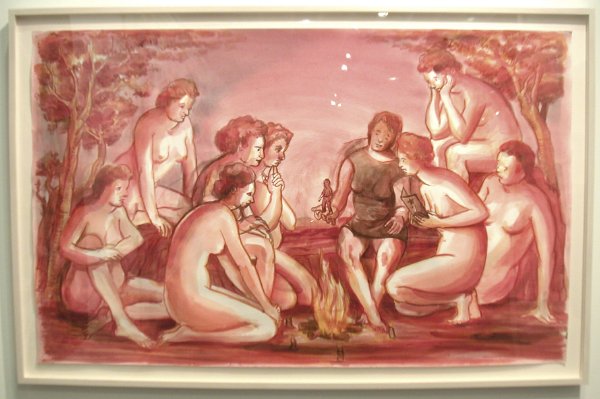
Nicole Eisenman untitled 2004 watercolor and pencil on paper 25.5" x 39.5"

I see this wonderful Nicole Eisenman drawing as the other school of Athens. The work was in Leo Koenig's exciting booth.

Alice Neel at Armory

NeelAliceEka.jpg
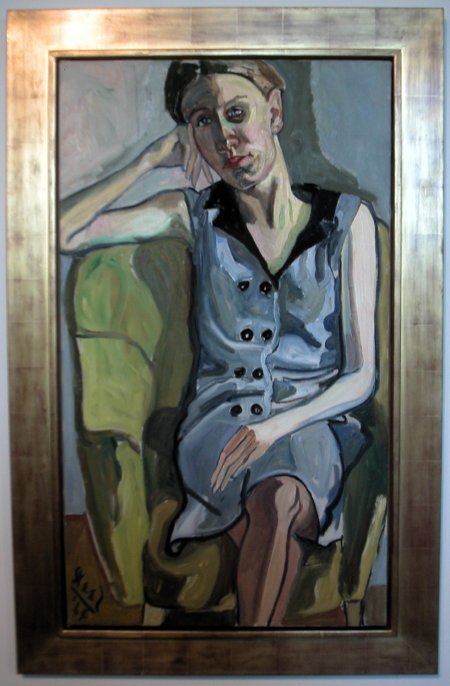
Alice Neel Eka 1964 oil on canvas

I turned the corner and there was this old master, except it was not old at all, even in the company of so much work by the truly young at Armory 05. This glorious portrait by Alice Neel was being shown by London's Victoria Miro Gallery.

Jeff Sonhouse at Armory

SonhouseJeff.jpg
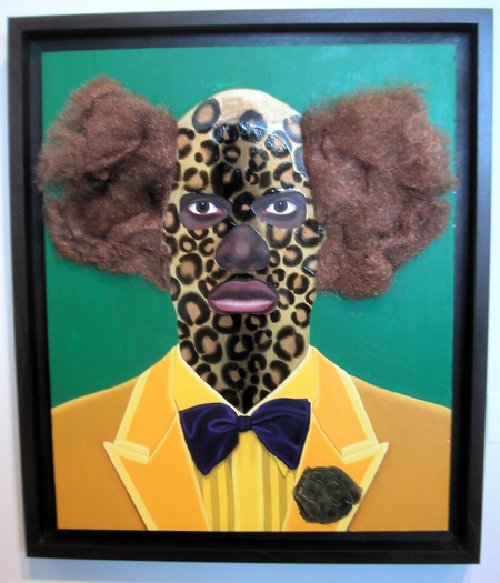
Jeff Sonhouse Green is For the Money, Gold is For the Honey, and Bronze is For the Bourgetto 2005 mixed media on wood 14" x 18"

This dazzling piece by Jeff Sonhouse was in Jack Tilton's booth.

Spencer Finch at Armory

finchspencer.jpg
Spencer Finch Sunset (south Texas 6/20/03) 2003 fluorescent lights, filters 25" X 40'

When I got home from a second trip to the Armory fair last night I saw that Tyler had already written about Spencer Finch's piece in the Postmasters booth, but I found this great image on my trusty micro and I didn't want it to languish. Sorry I didn't get a real closeup, because the piece is dynamite whether the eye is on top of it or as far away as the next pier.