James Wagner

Reuben Lorch-Miller and Heidi Schlatter at Schroeder Romero
LorchMillerHelicopters.jpg
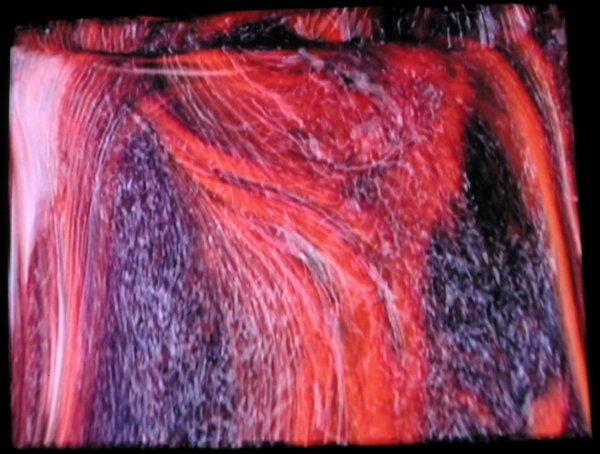
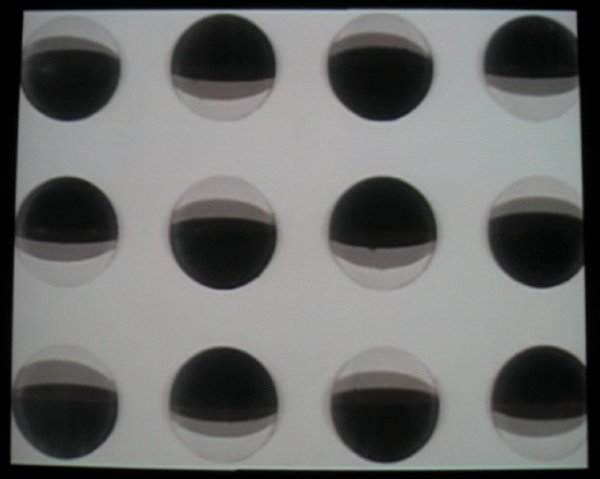
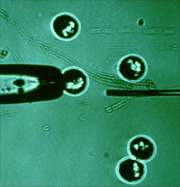
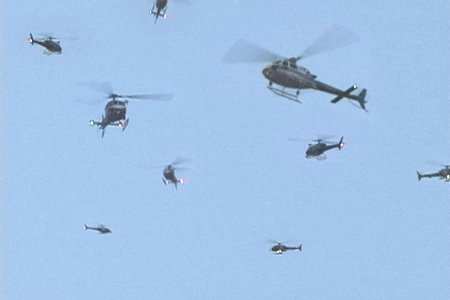
Reuben Lorch-Miller Untitled (Helicopters) 2004 video projection [still]

There was a time when my relationship to the helicopter was very simple. I absolutely loved these machines, and of course like most little kids I wanted one of my own.

Even if they had been used during the Korean War their role seemed to be fundamentally that of angels of mercy as they facilitated the evacuation of the wounded. Then, I think sometime during the horror of the Viet Nam years, I became aware of the concept of the helicopter gunship and the discovery deeply disturbed me: Helicopters were being used in anger. More recently these great noisy dragonflies have assumed an impossibly heavy role in several particularly indefensible contemporary wars in the Middle East, where they strike indiscriminate terror among both civilians and combatants whom we or Israel have labelled as the enemy.

Even here in a fundamentally peaceful Manhattan, while residents are not the target of helicopter-borne rockets and machine guns, we are all regularly assaulted day or night by the frightening whup-whup-whup of these almost unequivically sinister and fundamentally military flying machines as they pass or hover low above our homes, often shinning high-powered searchlights on apartments below.

Sometimes they come in packs and they stay in packs, and it is that very scary phenomenon which Reuben Lorch-Miller addresses in a powerful and strangely beautiful video currently being shown at Schroeder Romero* in Williamsburg.

I have to point out that although in the video the helicopters are for the most part only hovering in place, a still image like the one above is almost meaningless, especially without that nightmare sound. See the artist's site to download an excerpt which includes sound.
SchlatterHSR.jpg
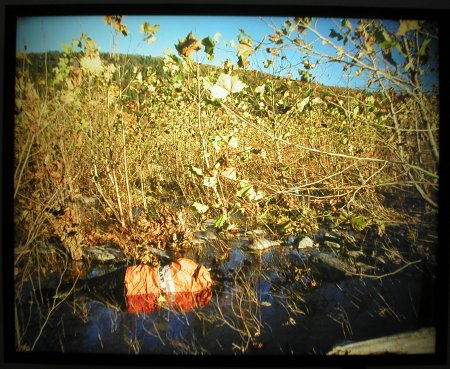
Heidi Schlatter Partridge Nest 2005 Duratrans in light box 16" x 20" [installation view]

In the main gallery Heidi Schlatter is showing rich lightbox photographs of staged deaths recorded in almost-ordinary landscapes. In each of these sets there seems to be something off - these are places neither quite natural nor obviously designed. The press release explains:

Heidi Schlatter's solo exhibition features lightbox images of rural locations in Switzerland and New York State, which draw connections between the natural landscape, photography and advertising. The recognizable logos in these oxymoronic scenes of faked deaths and accidents contrast the pervasive cultural optimism of branding and product placement with a sense of dread and doom.

* apparently because of a glitch, at the moment the gallery website does not include the current show

[image at the top from Schroeder Romero]
Jenny Saville

Saville2.jpg
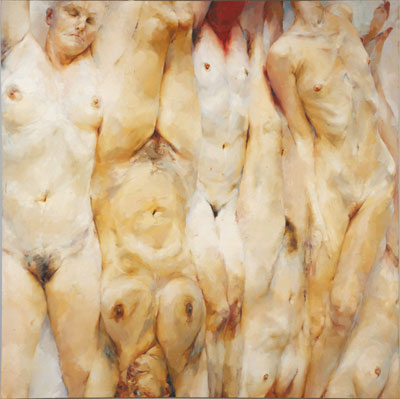
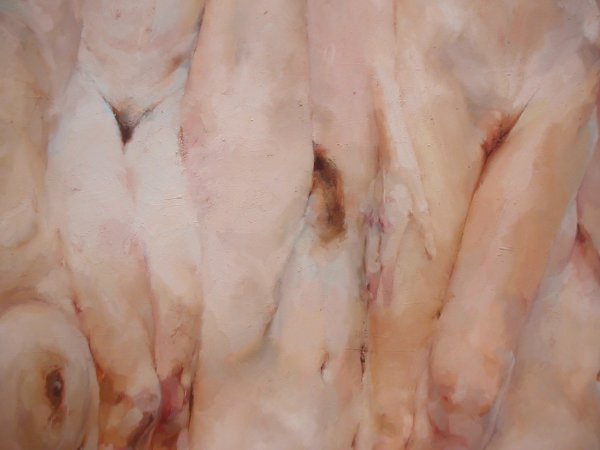
Jenny Saville Shift 1996-1997 oil on canvas 130" x 130" [large detail]

She doesn't need this humble blog to attract attention; she's already there. But after a visit today to, well . . . okay, I'll admit it, the vast halls of Gagosian, I couldn't resist broadcasting this gorgeous detail - even if it's a very poor substitute for being there with the paint.

Sayvillewhole.jpg
Jenny Saville Shift 1996-1997 oil on canvas 130" x 130"

[lower image from Gagosian gallery]

Ryan Humphrey on 24th Street

HumphreyHoggard.jpg
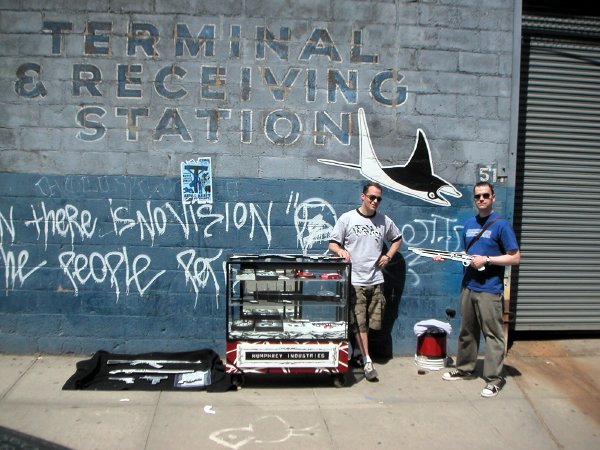
Ryan on the left, Barry with the sawed-off shotgun on the right

We hadn't yet left the seductive sidewalk gallery of Eric Doeringer early this afternoon when Barry and I spotted the Humphrey Industries/ open-air kiosk in front of one of the last auto repair garage/receiving stations left on 24th Street (fortunately, like the site Eric had chosen, it too was closed on Saturdays).

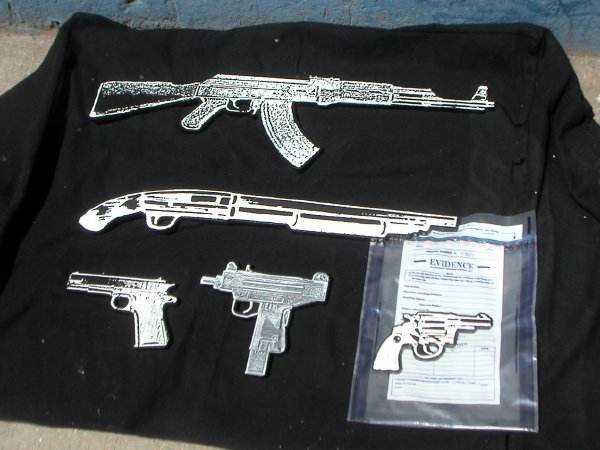
Absolutely anyone who knows us would not dispute my claim that neither of us is fond of guns or gun imagery, but I have to admit that Barry and I both found the particular charms of Ryan Humphrey's extensive, if very wooden, selection almost irresistable. In the end however we decided a painted canvas frisbee target (clay pigeon?) was more our style, even if we're almost certain to be back.

Humphreyguns.jpg
some of the merchandise available

Ara Peterson and Justin Samson at John Connelly

PetersonAraForcefield.jpg
Ara Peterson/Forcefield Third Annual Roggabogga Motion Picture 2002 video 6 min. 7 sec. [video still]

PettersonAra12Ball.jpg
Ara Peterson 12 Ball 1997 video 2 min. 51 sec. [video still]

SamsonJustininstallation.jpg
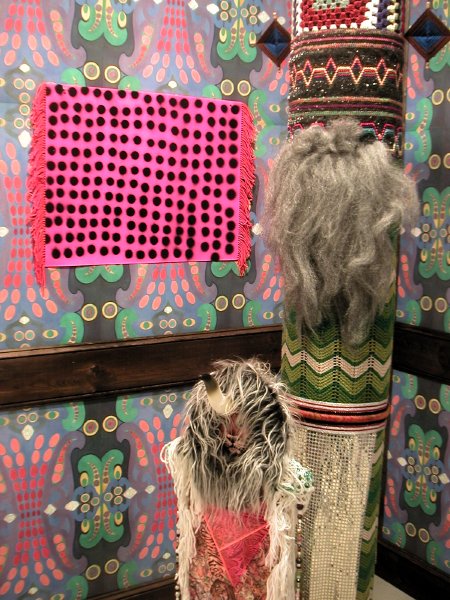
view of Justin Samson installation showing Nandor the First and Treebeard (2004 mixed media) in the foreground, Bactroban (2005 record cover collage with yarn) mounted on the wall behind

SamsonJuatinVisitors.jpg
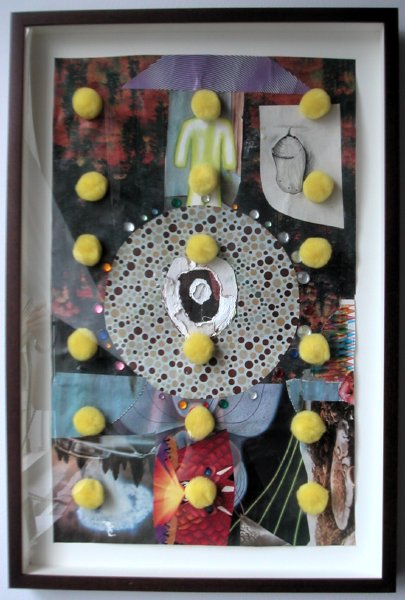
Justin Samson Visitors 2004 collage on paper 16" x 10" (19.75" x 13" framed)

John Connelly Presents continues to balance shows in two separate gallery spaces on the tenth floor of 526 West 26th Street, and they're always eye-openers, even for the most jaded art boulevardier. This month is no exception, with eleven abstract videos by Ara Peterson in one room, and Justin Samson's extravagant installation in his reconstruction of the main space.

Michael Ashkin at Andrea Rosen

AskinAdjnabistan.jpg
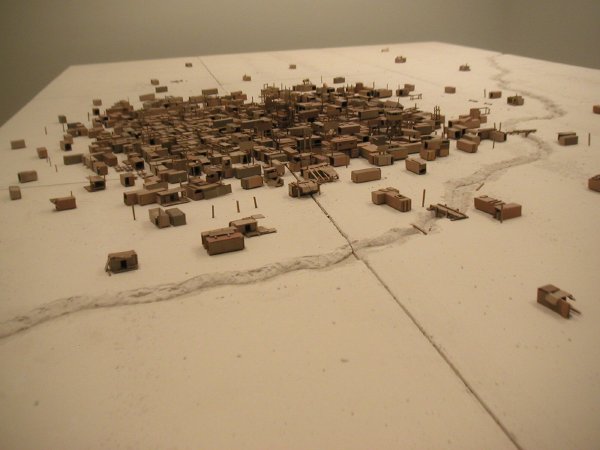
Michael Ashkin Adjnabistan 2005 recycled cardboard and gypsum 46" x 132" x 252" [large detail of installation]

Michael Ashkin's new large-scale piece, Adjnabistan, represents a significant departure from his handsome earlier work, which at least appeared to be about realism, even if it enclosed an angry conceptual core. The latest work, which almost entirely fills Andrea Rosen's project room, is both fundamentally and apparently conceptual, even if it retains enough of an element of realism to seduce the child in all of us.

From the press release:

“Adjnabistan” is the name of the anti-nationality I invented with a friend while traveling through the Middle East in the late 1970s. Derived from the Arabic “adjnabi” (meaning “foreigner,” “stranger,” or “other”), this land of impossible origin proved useful, especially in Iran, where, as an American, one needed to avoid treacherous political discussions. If said with the proper lightness of tone, “Adjnabistan” could provoke a smile or even be accepted without question. In any event, we could not be accused of lying or insincerity; in fact, the more I used this word over the months, the more I came to develop mental images of this shadow homeland. These images varied widely and, like a dream, spanned numerous geographies, but empathetically included aspects of the political and economic neglect evident in the landscapes through which we passed.

To illustrate the most extreme version of the schism between ideas and means, Ashkin imagined Adjnabistan as a community at the far end of exclusion, i.e., as a squatter/refugee/concentration camp built from used or abandoned shipping containers, situated in a fringe wasteland. The physical piece developed accordingly, with three forces asserting themselves: the inhabitants’ hopes and aspirations, the social, political and economic constraints they encountered; and finally, the artist’s own interests in developing a work of art. As the piece developed, fences were built, torn down and rebuilt. Watch towers became guard towers. Family compounds became prisons then perforated by fresh doorways. Structures too grandiose were dismantled and scavenged. The town underwent cycles of overflow and attrition. Populations thrived, perished or set themselves adrift in the surrounding desert.

Omigosh, I don't think there's ordinarily a connection between the two rooms, but I just realized the brilliance of a decision which brings together Ashkin and Andrea Zittel, who is showing work in the gallery's main space, part of the latter's continuing real and conceptual explorations of "the limitations of living space."

life after birth

stemcellballot.jpg
respect

A gentle letter to the editor in today's New York City Newsday ends with this terse critique of the Republicans' evil politics of stem-cell research: "After all, we may differ as to when human life begins, but it certainly does not end at birth."

The full text follows.

President George W. Bush's antipathy to stem-cell research is a paradox wrapped in a conundrum. How can he have any respect for human life when his rush to war has resulted in the deaths of thousands of innocent people?

To say nothing of his role as governor of Texas, where he executed numerous people. If Bush was truly concerned with the dignity of human life, his policies would be 180 degrees different in almost every category. After all, we may differ as to when human life begins, but it certainly does not end at birth.

Max Podrecca

Manhattan

Is anybody listening?

[image from <a href="stemcellballot.jpgnature.com</a>]

John F. Simon, Jr. at Sandra Gering

SimonJohnF.jpg
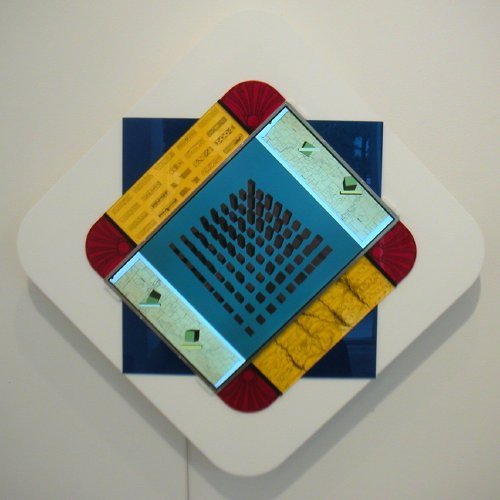
John F. Simon, Jr. Endless Victory 2005 software, Apple Powerbook G4, acrylic plastic 28" x 28" x 3.25" [detail/screen still]

Sandra Gering showed only two modest-sized works by John F. Simon, Jr. in the show which closed on Saturday. Either one however could stand in for an entire art collection, since each of the two computer screens mounted in exquisite cut and engraved Plexiglas frames presents an infinitely-changing image. The one shown above is Simon's take, in the words of the press release, "on the endless merging, dividing, overtaking, turning, starting and stopping motions" of the city which inspired Piet Mondrian's unfinished 1943/44 Victory Boogie-Woogie.

No image in either work will ever be repeated on the screen, so the pieces will be renewing themselves forever. You may not be able to afford one of these jewels, but if you could, you'd never have to buy another work of art for novelty alone.

The gallery installation showed four pieces from each of the two editions, only beginning to suggest the endless variations produced by the software.

There's really a lot going on here. The screen images are never entirely abstract, they regularly mimic three dimensions, and their inspirational sources are a balance of humanistic ideals and conceptual purity.

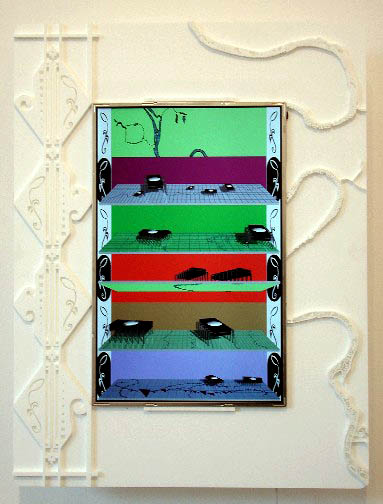
The second edition, Endless Bounty, emerges from the tension between Simon's urban lifestyle and his longing for nature. The software flips between the two ideals displaying maps, drawings, photographs and three-dimensional models in a continual effort to capture our gaze.

I'm really attracted to the intelligence and creativity of Simon's art, but he adds something most artists who work with computer code do not have: He knows how to draw, and it's always a part of his "machinery."

SimonBountyGering_2.jpg
John F. Simon, Jr. Endless Bounty 2005 software, Apple Powerbook G4, acrylic plastic 23" x 17.5" x 3.25" [detail/screen still]

[lower image from Sandra Gering Gallery]

Jesse Bercowetz, Matt Bua, Carrie Dashow at Jessica Murray

They've made landfall and explored Roosevelt Island but in the end it's apparently not quite what they or any of us thought it would be.

Jesse Bercowetz, Matt Bua and Carrie Dashow continue their investigation of the weird mythologies of a half-forgotten, long narrow island lodged in the middle of New York's East River with an installation at Jessica Murray. This is a project begun last year whose first forms "in which the artists assumed the role of underworld crypto-zoologists" were exhibited under the title Under Gone at PS1 in the fall.

In order to explore the island and its treacherous surrounding waters once known as “The Hell Gate” they [subsequently] launched a makeshift raft into the East River. In their new installation Pent-Up and Under Gone, Bercowetz, Bua, and Dashow explore their findings, as well as the Island’s oral and written histories, and are led to a new interpretation of the land as a growing monster of unpredictable powers, with a life of its own, undetermined by humans.

There's no way any image can prepare you for what they've installed, and as usual the work leaves me speechless (in a good way). Don't miss their huge "book."

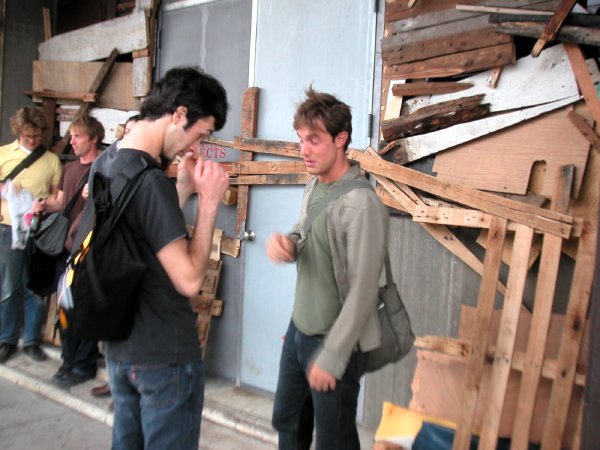
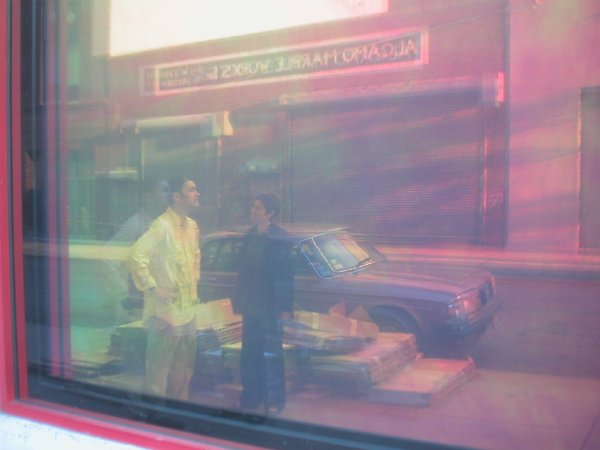
You're going to want to see it all, but you're going to have to find the gallery first: The huge 11th Avenue building was already partially veiled by a construction canopy, but the three artists have gone a step further. They've almost entirely covered the entrance to Jessica's neat minimalist rooms with boards and pallets which look much like the scrap wood you'd expect to find on parts of Roosevelt Island's muddy shore. Still, you should be able to just about make out the red lettering if you're on foot.

Murrayentrance.jpg
dust thrown up by gusty (West) river winds outside the gallery

Murraywindow.jpg
one of the two "enhanced" gallery windows as seen from the inside

MurrayPentUpUndergone.jpg
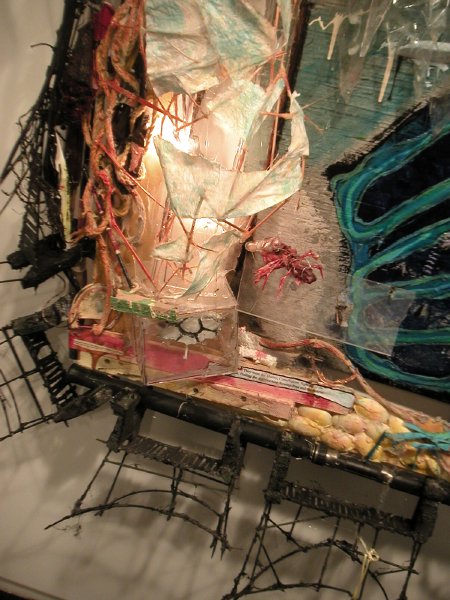
Jesse Bercowetz/Matt Bua Pent-Up and Undergone (panel) 2005 mixed media 64" x 88" x 18" [detail]