James Wagner

terror

Menezes2.jpg
Jean Charles de Menezes

The gang of men who accosted and chased a terrified young electrician into the tube where they shot five bullets into his head after he tripped and fell onto the floor of a car filled with people were plainclothes policemen.

Jean Charles de Menezes entered Britain with student visa; he may or may not have still been a legal resident three days ago, but on the other hand, especially by post-9/11 standards, it's clear he was not perfectly white.

I don't want to hear or read anything more about how the victim was responsible* for his own death - and that we should all expect the same treatment ourselves to save us from terrorists.

For more, see the post of a friend/acquaintance:

His English was OK, but he wasn’t fluent. He was pursued by up to 20 normally dressed men who screamed at him in a language that was not his own. Jean comes from Brasil, a country where violent crime is a lot more ‘in your face’ than it is over here. A group of plainclothes men screaming at you, chasing you, you fucking run. Brasilian police frequently shoot the public indiscriminantly, there was an incident earlier this week - 10 killed. Maybe Jean had thoughts about this when he ran, I don’t know. Watch "Bus 174".

*
including the only two letters read on the BBC News Hour this morning

[image from finn]

darkness settles over the land, this time maybe permanently

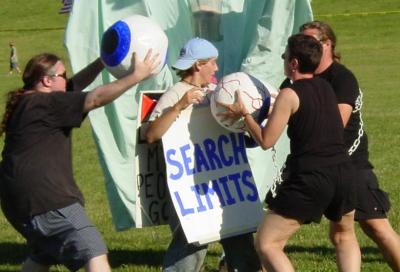
searchlimits.jpg
the Madtown Liberty Players portray the Fourth Amendment under attack (two years ago)

The House voted today to make the "Patriot Act" permanent. In what may be the least patriotic vote ever recorded in that chamber, our representatives effectively moved to revoke the Fourth Amendment for all time.

My countrymen are cowards. They are ignorant of themselves and of the world. The unknown is always what we fear, and this country has an enormous dark store of the nameless feeding its private terrors.

Americans don't know who they are, and they don't know the outside world. We never had to learn anything about either subject, and for pretty much the same reason: the country was just so big; we were busy filling it up and we could pretty much ignore everyone outside our borders and most of them inside. We don't like people anyway, whether they're from another continent, another city, another neighborhood, another family. I don't even have to mention our class, racial and ethnic insularity, they are so well-documented. We don't even like to be too close to those in our own families. We like the separation the oceans furnish us and we wish there were others on our northern, and especially southern, borders. We want as much space as we can manage to arrange between ourselves and the next fellow's place, and everyone in the family should have a private room and bath, as well as his or her own car.

I'm appalled, but not surprised, by this cowardice on the one hand and on the other a welcoming, even enthusiastic, support for, excuse the expression, but I do know my history, clearly "fascist" concepts of political control that are being embraced by so many of our fellow freedom-loving Americans. These are people who will still boast tomorrow that they enjoy a unique island of liberty and democracy blessed by a god who favors their virtue.

America has indeed been terrorized. It was the work of a single brilliant and monstrous blow, but the land of the free and the home of the brave is now willing to trash its heritage for the mere illusion of security. While most of its people are willing to admit the trade, they don't see the disconnect.

We're doomed.

[image from Madison Indymedia]

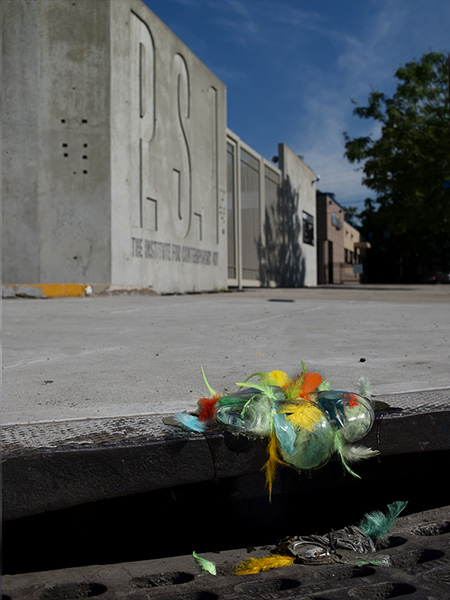
Bethany Bristow in the gutter

BristowBethanyalmostguerilla.jpg
Bethany Bristow, dropped off on the way to the museum

I've had this weird reaction to her art since coming across it (in a switch, it was sometime after we had met). Bethany Bristow's messy alien-organic sculptures attracted and repelled me at the same time, and I even forgot that this response usually meant that I was likely to end up liking a work, or a body of work, very much.

I now like it very much indeed.

She has work spread throughout the current PS1 Greater New York 2005 show, all of it placed as if it were something waiting to be cleaned up. But nothing worked so well for me as this image I saw in a link on an email she sent out this afternoon. Maybe it's the daylight, maybe it's the space. It's a great photograph, the piece is perfectly installed and I can't really blame the artist of a guerilla installation for having art inside a museum at the same time.

It's all public art, even if you may need $5 to see the stuff inside.

[image from Bethany Bristow]

Danny Lyon on "The Destruction of Lower Manhattan"

No, not that one, it's about the one we ordered.

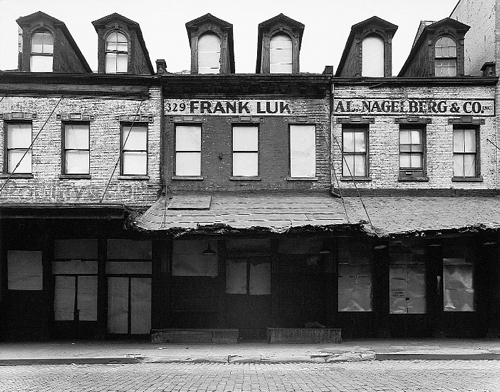
Lyon2.jpg
Danny Lyon 327, 329, and 331 Washington Street, between Jay and Harrison Streets

It's all gone now. Sixty acres of lower Manhattan's nineteenth-century buildings were demolished during the mid-sixties, including what became the site of the World Trade Center towers. There was also a new vehicle ramp to be added to the Brooklyn Bridge, Pace University was to be enlarged, and historic Washington Market was moved to the Bronx, its buildings reduced to rubble.

Danny Lyon writes today in The Village Voice about his documentation forty years ago of a massive "urban renewal" project in Manhattan:

It was a huge story in New York City at the time. (I'm from Queens, and when you're from Queens, you really admire Manhattan . . . and this was the most historic part of Manhattan. The oldest part of Manhattan was vanishing.) And it was an ignored story at the time, or I wouldn't have done it. Part of how I saw myself, as a journalist, was finding the truth and delivering it to the American people. To put it in a really crude way.

. . . .

You have to understand that I was—and still am, although I've aged and mellowed— I was obsessed with the power of photography. I thought you could take a bike rider, Harley-Davidson, roaring along, and that this photography was so miraculous that you could somehow contain that power in the negative. Unlike this guy who would go around the corner and die, or run out of gas, that the thing that you contained would be for all time. . . .

I had the power to use all of these buildings and preserve them for the future. And if anybody wanted to experience [the] Lower Manhattan that had stood there for 150 years, they would have to come to my photographs! Which would be washed and preserved and in the New York Public Library. . . .

. . . .

I understood that the way to deliver photography as news was to do books. That's what I think the news should be: an individual's statement about how he sees reality. Or as Ferlinghetti says, "The dog trots freely in the street and sees reality. . . . "

The book's about architecture. This country's committing architectural suicide. It's doing it right now, this moment. Not 37, 38 years ago. This is nothing, what they did down here: The 60 acres is nothing. We're destroying 6 billion acres of America, and we're doing it right now. We're doing it because you can get a mortgage for 5 percent.

Anybody can do anything anywhere.

We can't expect a city to remain the same forever, but we never needed any of the "improvements" for which these neighborhoods were sacrificed, and don't even mention the aesthetic crimes committed.

Danny Lyon is an artist and a poet.

[image from Gay City News, courtesy of the Edwyn Houk Gallery]
more on Smolkatown

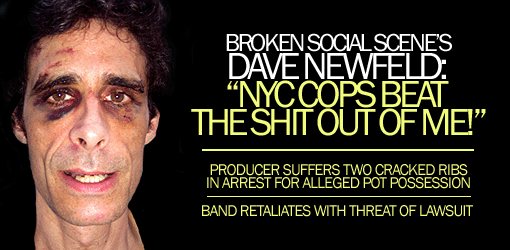
DaveNewfield.gif
for picking weeds

It probably won't be news to anyone in the new music scene, but this account of vicious New York city police thuggery may be a surprise to many of my readers, even those who have seen my Chief Smolka posts; and even those who are familiar with the police camp that the Village's Washington Square Park has become in recent years. Smolka is in charge of the street crimes unit which assaulted the Broken Social Scene's Dave Newfield in the park last Thursday.

The cop's official title is "Commanding Officer Patrol Borough Manhattan Assistant Chief Bruce Smolka," according to the NYPD site. I call him very dangerous.

Who will protect us from those who say they will protect us?

This is an excerpt from the pitchforkmedia report:

So, [his friend] exchanges $20 with a dealer in the park while Newfeld stands by watching the events unfold. As Newf tells it: "We walk around the corner, and all the sudden I'm tackled in a football style attack, like a mugger would do, you know? You grab the person and catch them by surprise and they ambush in a football tackle. And then they're like, 'Police, police, police! Fucking put your hands behind you!'" Due to the lax drug laws in Canada [his home], Newfeld says he didn't connect what he assumed to be a mugging with his schwag score, assuming the "police" claim was a ploy by thugs to keep their victims passive for an easy stick-up.

"They started punching me in the face and beating the shit out of me and throwing me on the ground, so I'm trying to get away-- not fight them back, because I'm not capable of that, but just to escape. And then they threatened to break my hand and I'm like, "No, don't break my hand! I'm a musician. I gotta fuckin' play tomorrow! And so I'm really freaking out, and at that point I thought, 'Just take my wallet, whatever. Don't break my hand. My wallet's not worth it.'" By now, Newfeld's pal was cuffed on the ground, and finally decided it was time to break the news: "They're cops! Submit!" Oh, and P.S., whoops!

After being thrown in the back of a paddywagon, Newfeld was left to sit with a handful of shady characters while the 5-0 went around picking up other perps. He was then taken back to the station in pretty poor shape, strip-searched (whuh-oh), and, having been left in a cell for an hour or two, taken to Bellevue Hospital to have his beatings checked out. It turned out he'd suffered two cracked ribs. While in his hospital bed, he was given a report detailing the charges against him-- four counts of assaulting an officer and possession-- which still stand as of press time.

[image from pitchforkmedia; story tip from a reader, whose email subject line read, "where's there's smolka, there's fire..."]

just about as brutal and effective as our campaign in Iraq

wallAbuDis.jpg
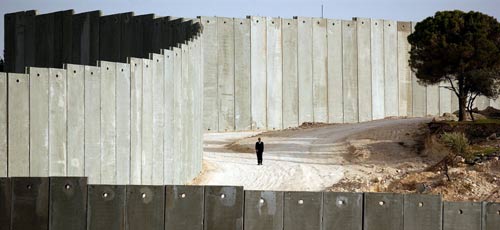
a Palestinian man walks next to a section of a wall eight-meters high built by the Israeli government, arbitrarily separating Jerusalem (and some additional annexed lands) from the Palestinian suburb of Abu Dis

We will not prevent terrorist acts by raising walls or bombing innocent strangers with sophisticated weaponry; by increasing the legal penalties for posession of a bomb; by spying on each other, high-tech or otherwise; by humiliating "the other;" by outlawing nail files or lighters; by putting an armed guard in every environment which has been a previous target; by incarcerating all the brown people on earth; by staying at home behind drawn curtains.

If we want to see it cease, we have to look to the cause of the terrorist response, not its manifestations. And it is a response; terrorism is always a response of the weak to the assaults of the powerful.

Terrorism feeds on imperialism. Neither of these is a state, merely a tactic; eliminate the imperialism and the threat from terrorism will disappear. We will never be made safe by building walls or by extending the power of our own state at home or abroad; the entire planet will survive and prosper if we recognize the appropriate limitations of that state and the proper proportion of our people, and placing both in the community of all nations and peoples.

[image from Newsday by Moises Saman]

a more organic minimalism at DCKT Contemporary

SteinhilberDuck.jpg
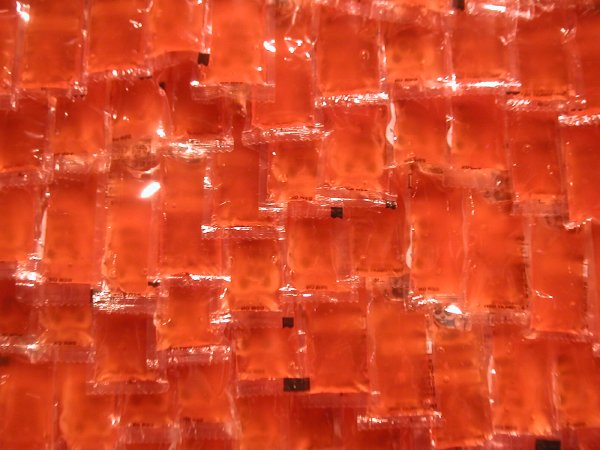
Dan Steinhilber Untitled 2003-2005 duck sauce, plastic 60" x 80" [detail]

It's a good thing. The art, for sure, but also it's a good thing that gallery shows which open in late June are often extended through much of the summer. Distracted by the heat and humidity of July in New York, I almost missed posting something about this one. Tyler Green has curated a beautiful exhibition at DCKT, a very cool show of cool minimal art by Rosana Castrillo Díaz, Augusto di Stefano, and Dan Steinhilber.

The curator's conceit is the manner in which the work of these young artists (and I don't think there's a single piece here which is over a year old) relates to an older generation of American minimalists - that is, absent the hard edges and right angles. A less ideological, more organic, even humanist minimalism?

Yes, Steinhilber's large work on the north wall is composed entirely of small packets of duck sauce, and it really glows. Nothing else in the room looks anything like it, even Steinhilber's other two pieces. The three artists' very individual aesthetics don't overlap even in this modest-sized space. They're all beautiful, and together a perfect fit.

difficult music for difficult times: an appreciation

[of a kind of harmony]

Shadowtime.jpg
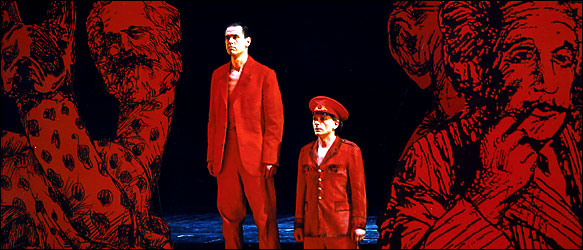
and I'm also very fond of red, when it's used well [scene from "Shadowtime"]

Ferneyhoughtimemotion.jpg
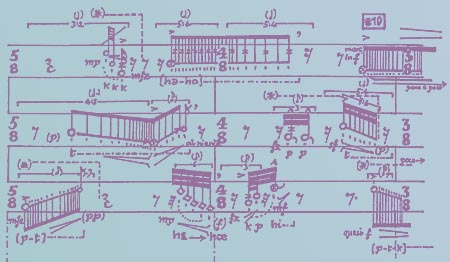
Brian Ferneyhough Time and Motion Study III 1974 16 mixed voices, percussion, live electronics [detail of the score]

I had intended to get tickets to Brian Ferneyhough's new opera, "Shadowtime," which receives its American premier next week, from the moment I had heard about it. But the Lincoln Center Festival flier we had received weeks ago had very soon been buried underneath competing mailings and was almost immediately forgotten - until this afternoon, when I read Jeremy Eichler's piece, "A secular Messiah gets His own Opera," in the NYTimes Arts&Leisure section. I immediately looked for the Festival site on line and then grabbed the phone, fearing that there might no longer be anything available but my best chance would be with a human voice. Then even as I was doing this I had to remind myself that this was not "La Boheme." The world wasn't going to be beating a path to Columbus Circle in order to hear an opera about "an arcane cultural philosopher" featuring "fantastically intricate music, with nothing as old-fashioned as a tune in sight," in Eichler's words - even if I had been seduced immediately.

While the two paragraphs from near the conclusion of the Times piece I'm copying below may not entirely explain my own love of difficult music (which is as much about the vulgar appeal of its invention, its energy, its novelty and its provocation as it is about its intellectual virtues), they do say something about the social and political utility of difficult art - in any medium.

"Shadowtime" had its premiere last year at the Munich Biennale, and critical reaction ranged widely. The Süddeutsche Zeitung hailed it as "an apex of modern operatic artistry," but The Sunday Times of London described it as overly cerebral, "an abstract idea of an opera rather than the thing itself." The truth may well depend on one's definition of modern opera.

Mr. Bernstein [Charles Bernstein, the librettist], for his part, readily concedes the many difficulties of "Shadowtime," and argues that they arise not only by design but by necessity. "Clarity is valuable in many situations, but not necessarily in art," he said in a recent interview at his Manhattan apartment. "Many will no doubt be befuddled, just as a work that seeks to be clear risks boring people. These are the risks you have to take."

Yet more seems to be at stake than simply keeping an audience challenged. When pressed, Mr. Bernstein echoes Benjamin's friend and colleague Theodor Adorno, who defended difficult music as having its own social value precisely because it teaches us how to withhold understanding and therefore helps us resist the allure of false clarity in the world beyond the concert hall. Complexity, in other words, is a worthy ideal in art because reality is even more complex and dissonant than the thorniest work of modernism, even if politicians and the commercial culture reassure us that everything is simple, clear and harmonious.

Oh yes, I had no trouble getting two good seats on the aisle in the orchestra, and for a fraction of the price of seats at that older and much more famous opera venue where they don't seem to be able to get past "La Boheme."

[first image from the NYTimes; second image from tagederneuenchormusik]

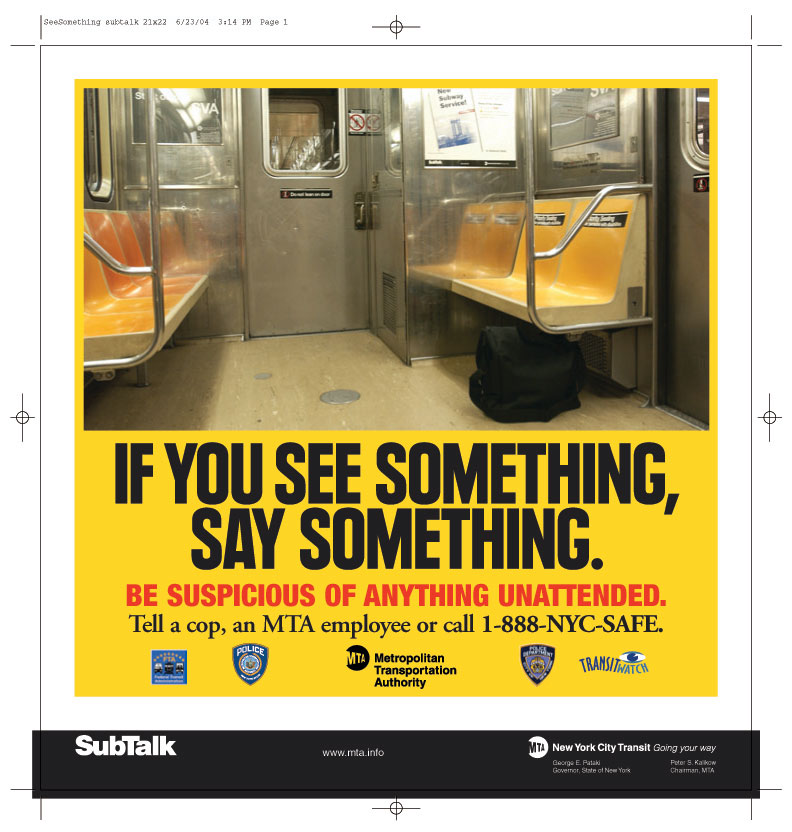
MTA: stadium treated as emergency, but security gets yawn

MTAseesomething_hi.jpg
leaving it up to the riders

Barry has just about covered the issue, with the help of Newsday's estimable Ray Sanchez, but a letter to the editor published in the NYTimes helps to illustrate the scale of the criminal incompetence and negligence of those at the top by bringing up the most recent scandal involving the MTA:

To the Editor:

The terrorist blasts in London and a similar attack last year in Madrid dramatically point to the vulnerability of New York's transit system to a similar attack.

Despite setting aside nearly $600 million [state and federal money] to secure the transit network against a terrorist strike, the Metropolitan Transportation Authority has accomplished little since 9/11. It was not until March 2003 that the agency announced a plan to address the transit system's weaknesses.

In fact, the lion's share of the money has not been allocated. The agency's most public initiative is a failed proposal to ban photography by straphangers.

Its foot-dragging is especially unsettling when contrasted with the speed with which it rushed through a deal for the proposed West Side stadium. [the italics are mine]

Instead of issuing color-coded alerts, the federal government and the M.T.A. should urgently undertake measures with existing money to enhance security.

Manuel Cortazal
Bronx, July 7, 2005

Wish us all luck. It looks like we're going to need it.

[image from the MTA]