Allan Pettersson and Sergiu Comissiona
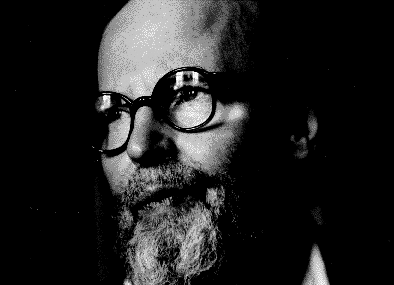
Allan Pettersson
It begins in the middle, the sounds suggesting that you have been there listening all along. In a way, you have, since the symphony is Allan Pettersson's Eighth (1969), and it is only one section of a very long song. The symphony closes with the orchestra slowly dipping back into the dark pool from which it had emerged some fifty minutes earlier.
This 20th-century Swedish composer (1911-1980) completed fifteen symphonies and together they feel very much like a single, endless piece, the powerful introspective work of an entire lifetime. His song is one of great sadness, although it may also contain the faintest suggestion of hope, even if that hope may only be for the extension of a life of pain, or the rebirth of life - anticipated as one of pain as well.
"Jag är ingen tonsättare, jag är en ropande röst (något som ej får glömmas), som hotar att dränkas i tidsbullret."
"I am not a composer. I am a voice crying out, (something that should not be forgotten) that threatens to drown in the noise of the times."
In the early 20th century Sweden had not yet become the extraordinarily successful society it is today. Large numbers of Swedes were still leaving the country as emigrants. Pettersson's childhood reflected the distress of that society and his own immediate family, and its physical scars left him in pain for the rest of his life. He died in his late 60's after having been housebound for ten years.
The music is profoundly disturbing, but achingly beautiful, and it owes little to the fashions of its century. At the time of the composer's death I had barely begun to assemble my collection of his music. I concentrated on each of the symphonies (the epic form which almost-completely dominated his output) and in the end I managed to find all except the uncompleted First and Seventeenth. But while the record of the music survives, on my own LP and CD shelves, and surely on those of other admirers, I never hear of a public performance today. Has Pettersson become just too dark for our own new dark age?
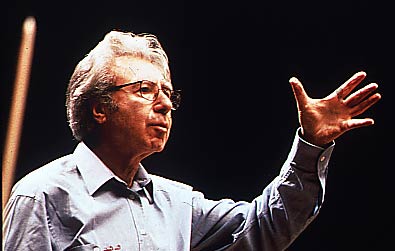
Sergiu Comissiona
My romance with the post-classical symphony form began in the 60's with Mahler, moved through Bruckner, Nielsen and Sibelius to Shostakovich, whose death in 1975 seemed to close the door to this extravagant world. But in Boston in 1980 I spotted a beautiful Deutsche Grammophon LP with a color photograph of a kindly-faced bearded man in profile on a rich apple-green ground. In those years the LP art certainly did sell music! But that's properly another story. Inside this particular sleeve was a recording of Petterson's Eighth Symphony by the Baltimore Symphony conducted by Sergiu Comissiona, then its music director.
I immediately fell in love with the composer's music. I did not hear of his death later in that year until much later. The performance on that recording is magnificent, and on its evidence alone I based my admiration for the conductor. Sergiu Comissiona died in his hotel room in Oklahoma City last Saturday, only hours before he was to perform as guest conductor of the Oklahoma Philharmonic.
Joel Levine, music director of the Oklahoma City Philharmonic and a longtime friend of Comissiona's, filled in for him Saturday night and led the orchestra through a powerfully emotional performance, said William Cleary, past president of the Oklahoma Philharmonic Society.
"It was like a concert unlike any I have been to, and I've been going for 40 years," Cleary said. "The orchestra got three standing ovations during the first number, and I've never seen that before."
And from this fan, a belated and very humble thank you, Maestro.
[image of Pettersson from Passagen Hemsidor, image of Comissiona from Asian Youth Orchestra, Pettersson quote from Paul Kenneth Cauthen]